
WJ Steyn, SwiNE Nutrition Management
Efficient resource utilization is paramount to achieve sustainable and cost-effective production in the swine feed industry. Food and feed by-products, also known as co-products, play a crucial role in addressing challenges related to feed availability, cost, and environmental impact.
These co-products, derived from various food and agricultural industries, offer valuable alternatives to traditional feed ingredients, providing a means to reduce waste and improve the overall efficiency of swine production systems. Additionally, the concept of upcycling has gained significant attention as a strategy to transform waste into valuable resources, promoting environmental stewardship and economic viability. This article explores the significance of food and feed by-products in the swine feed industry, focusing on their benefits, utilisation, potential challenges, and the importance of upcycling practices.
Food and feed by-products provide numerous advantages in the swine feed industry.
Firstly, they offer a sustainable and environmentally friendly solution by utilising materials that would otherwise go to waste, thereby reducing organic waste sent to landfills and minimising environmental pollution and greenhouse gas emissions.
Secondly, these by-products serve as cost-effective alternatives to traditional feed ingredients, resulting in reduced feed costs and enhanced profitability for swine producers. Co-products from food processing, such as cereal grains, fruit and vegetable pomace, and bakery waste, offer valuable nutrients at lower prices.
Moreover, food and feed by-products diversify the nutrient composition of swine diets, introducing different sources of protein, energy, fibre, minerals, and vitamins. This promotes more balanced and nutritionally complete feed formulations, contributing to improved swine health and performance.
The utilisation of food and feed by-products in swine feed requires careful consideration of their nutritional composition, safety, and processing requirements. Various by-products, such as cereal grains (for e.g., wheat bran, rice bran, and corn gluten feed) and oilseed meals (for e.g., soybean meal and sunflower meal) are commonly used in swine feed formulations due to their contribution of energy, fibre, and protein to meet the overall nutritional requirements of pigs.
Bakery waste can provide a source of energy, protein, and minerals, although caution must be exercised to ensure its safety for animal consumption by avoiding potential contaminants or additives.
Co-products from the brewing and distilling industries, such as brewer’s grains and distillers dried grains with solubles (DDGS), are widely utilised in swine diets due to their rich protein, fibre, and energy content, making them valuable alternatives to traditional feed ingredients.
While food and feed by-products offer numerous benefits, their utilisation in swine feed comes with challenges. Ensuring the safety and quality of these by-products is crucial, requiring proper handling, storage, and processing techniques to prevent contamination and maintain pig health.
The variability in nutrient composition among different by-products necessitates careful formulation and analysis to achieve proper balance in swine diets. The inclusion of co-products may require adjustments in the levels of other feed ingredients to efficiently meet the nutritional requirements of animals at different stages of growth.
Another challenge lies in the availability and consistent supply of by-products, which can be influenced by regional factors, seasonal variations, and fluctuations in the food processing industry. Establishing reliable supply chains and fostering partnerships with food processors and swine producers are essential to ensure a consistent source of co-products.
Additionally, upcycling by-products introduces further considerations. Analytical methods and quality control measures must be implemented to address the variability in nutrient composition and digestibility. The presence of anti-nutritional factors, mycotoxins, and contaminants necessitates thorough analysis and risk assessment before inclusion in swine diets.
Maximising the utilisation of by-products in the swine feed industry is crucial for sustainable and cost-effective production. These by-products offer sustainable and environmentally friendly alternatives to traditional feed ingredients, contributing to waste reduction, environmental impact mitigation, and improved efficiency in swine production systems. The concept of upcycling further enhances the value of these byproducts, transforming waste into valuable resources and promoting a circular economy.
Practical advice for pork producers navigating this journey includes establishing robust supply chains and partnerships with food processors. This not only secures a consistent source of by-products but also strengthens the collaborative efforts towards sustainable and efficient swine production.
The utilisation of food and feed by-products in swine production is not just a solution; it’s a commitment to sustainable and cost-effective feeding practices. The winds of change are ushering in a new era where innovation, environmental stewardship, and economic viability converge to shape the future of swine nutrition. By navigating these changes thoughtfully and embracing the opportunities they present, pork producers in South Africa can usher in a new age of resilience and prosperity for their industry.
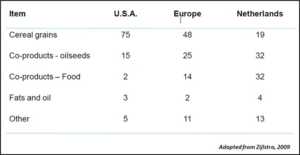
Figure 1: The use of grains, by-products and co-products in different pork producing regions. A typical grower diet in the Netherlands consist of average more than 60 % co-products.
