
Pig farming is perhaps one of the most misunderstood forms of Agriculture in South Africa. In a country that is known for its love of meat, braais and shisa nyama’s, the per capita consumption of pork is dreadfully low, particularly when compared to other types of meat. The average South African eats only 5,2kg of pork per year, this is less than a third of the beef consumption (18,1 Kg) and only 13% of chicken consumption (40Kg). If we zoom out even further, we will see that 36% of global meat consumption is pork, with countries like Spain and Poland having per capita intakes exceeding 50Kg.
There must be a reason that meat-loving South Africans are not eating more pork. I think, many South Africans see pigs and pig farming as “dirty” and see pork as unhealthy and intimidating to cook. This is perhaps a cultural thing, with stories of tape worms and the like being passed down from one generation to the next. They likely also have an image in their minds of what a pig farm looks like that is far from reality.
Pig farming is often looked at in a negative light by the public and as a result its contribution to global pork supply is underestimated. If we can help the public to think differently about pig farming, we can all appreciate more the contribution it makes to food security, scientific research and environmental stewardship. All three of the previously mentioned qualities often go hand in hand. If we take into account the improvement that genetic research has brought to the feed conversion ratio (FCR) of pigs, it is easy to see the benefits that this will bring for both an environmental and a food security point of view. In the not-so-distant past FCR’s of more than 5:1 was common, and now we are seeing values of 3 or 2,7:1 and research suggests that FCRs of 2:1 are not far away. To try and put this in perspective, by improving FCRs by 0,01:1 we can decrease the global usage of pig feed by 1.4 million tons, but we would still produce the same amount of pork. This provides a massive opportunity to provide high quality protein products to those who need it while decreasing the pressure we place on the land to produce the cereals used in feed. Furthermore, many pig farmers in South Africa and around the world produce their own cereals to feed to their pigs and will use the manure from the pigs as fertilizer. This not only means that less manure ends up in the environment, but also less nitrogen-based fertilizers need to be produced. A true win-win for the environment and the farmer’s bank account.
A mentor of mine often says, “pigs don’t need soya and maize, they need protein and energy”. In recent years, more and more South African farmers have been borrowing some innovative ideas from European pork producers that embrace this sentiment. The use of by-products, co-products and former food products (FFPs) from the human food industry to feed pigs. This allows pork producers to feed their pigs better, while preventing food wastage and sparing costs. There is an unbelievable amount of these food materials that are condemned on a daily basis that are destined for landfills. In actuality much of it is not condemned because it is unsafe, but rather for aspects that have no effect on the nutritional value of the product, such as damaged or incorrect packaging. The pig industry has a unique advantage over other livestock production systems as they can use far more of these products than the others due to the nature of the pig’s digestive tract. Once again, this strategy has benefits for both food security and the environment. Pigs are able to convert these unwanted materials into nutrient rich food that can go back into the human food industry, thus improving food security, while simultaneously preventing landfills filling with organic matter that could lead to health risks and preventing the energy and resources used to produce it in the first place from being wasted.
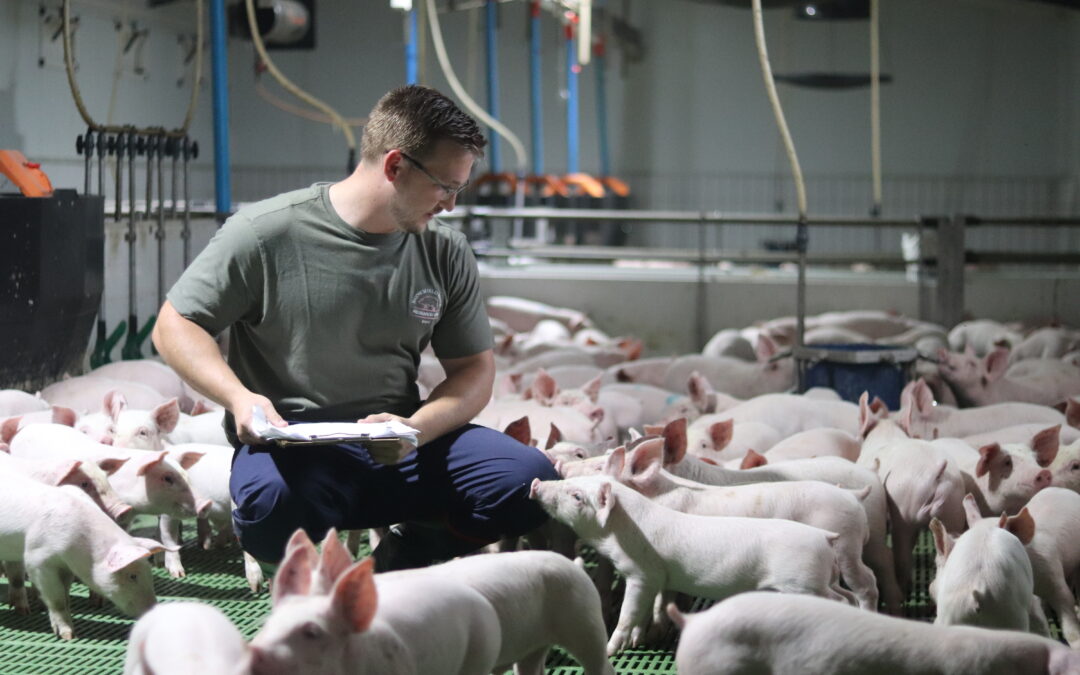
As mentioned previously, there is likely a disconnect between what a pig farm really looks like and what the public thinks a pig farm looks like. Most people imagine mud puddles, with pigs eating kitchen swill. While the majority of pork comes from highly sophisticated farms that place a lot of emphasis on biosecurity and the health of the animals. Along with these considerations, there are many ethical questions that come up when pig farming is discussed. An important fact to remember is that an animal that is stressed or unhealthy will not be as productive as an animal that is comfortable in its environment, and this is something that every farmer knows. For this reason, it is in the farmer’s best interest to maximize the health and minimise the stress of their herd. To help the farmer in this regard, there is constant stream of research and innovation improving the farming practices and conditions in which pigs are farmed as well as the impact the farming practices have on the environment and the consumer.
Rethinking pig farming means moving beyond outdated assumptions and embracing new practices that make pork production more responsible, efficient, and humane. Whether through regenerative grazing, innovative feed sources, or improved animal welfare, the industry is proving that it is possible to think differently about how pigs are raised—and why it matters.
